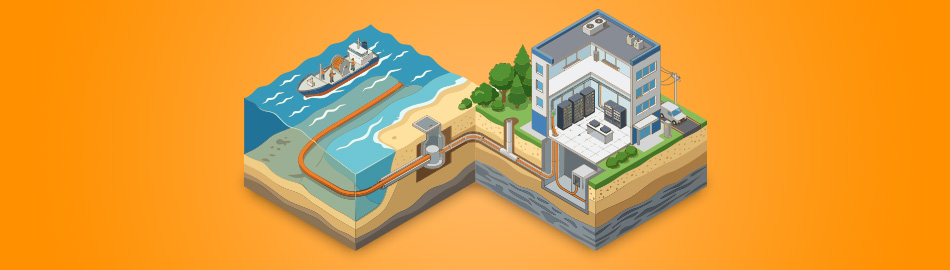
The world protects submarine cables through several complementary measures: government regulation and investment (in the European Union, for example, the EU Action Plan on Cable Security), alternative routes, modern monitoring, and faster repair procedures. The effectiveness of these measures also depends on operators having accurate knowledge of their own network resources and interconnections.
When we send a message across the ocean, watch a broadcast from the other side of the world, or use cloud services, our data usually doesn’t travel via satellite. According to the European Commission, undersea fiber-optic cables account for approximately 99% of intercontinental internet traffic. This infrastructure is nearly invisible to users, yet it is crucial for the global economy, government operations, and national security. A series of cable breaks in the Baltic and Red Seas has shown just how serious the consequences of disruptions to this infrastructure can be.
Outages: Mostly Accidental, but the Threat of Sabotage Is Growing
According to the International Cable Protection Committee (ICPC), the global undersea network comprises approximately 500 cable systems with a total length of 1.8 million kilometers. There are approximately 150–200 failures annually, 70–80% of which result from accidental human activity, primarily fishing operations and damage caused by ship anchors. Other causes include technical failures, underwater landslides, and seismic events.
In recent years, incidents in the Baltic Sea have drawn particular attention. In November 2024, the C-Lion1 cable connecting Finland and Germany was damaged, as was the connection between Sweden and Lithuania. These incidents raised suspicions of possible sabotage and heightened concerns regarding the security of critical infrastructure. However, not all cases of damage in the Baltic Sea have been deemed intentional acts; therefore, it is necessary to distinguish between confirmed causes and mere suspicions.
Another example occurred in September 2025. Damage to several cables in the Red Sea caused communication disruptions in India, Pakistan, and the United Arab Emirates, among other places. The issues also affected Microsoft Azure users. The company rerouted traffic through alternative paths, which helped mitigate the impact of the outage; however, some connections experienced increased latency. The incident demonstrated that damage to infrastructure in one region can affect the quality of services provided thousands of kilometers away.
Why Is Protecting Submarine Cables So Difficult?
The scale of the infrastructure remains the greatest challenge. Cables run for thousands of kilometers along the seafloor, often at great depths, making constant physical monitoring impossible. Additionally, many connections are concentrated in the same straits, bays, and landing points, creating areas particularly vulnerable to disruptions.
Repairing a damaged cable requires specialized vessels and appropriate equipment. The time it takes to restore service depends on the location of the failure, weather conditions, vessel availability, and the necessary permits.
Another challenge is the fragmented responsibility. The infrastructure is owned by telecommunications operators, consortia, and global technology companies, while protecting it requires cooperation with government agencies and authorities responsible for maritime security.
The European Union Is Investing in Infrastructure Security
In response to growing threats, the European Commission presented the EU Action Plan on Cable Security on February 21, 2025. The document focuses on four areas: incident prevention, detection, response, and service restoration, as well as deterring potential perpetrators.
The next step came on February 5, 2026, when the Commission presented the Cable Security Toolbox, a set of risk-mitigation measures, and a list of priority projects known as the Cable Projects of European Interest (CPEI).
At the same time, 347 million euros were allocated under the Connecting Europe Facility Digital program for strategic subsea infrastructure projects. This amount includes, among other things, 20 million euros for the development of repair capabilities, including modular solutions that enable faster restoration of damaged connections.
The European strategy aims not only to better protect existing cables but also to develop alternative routes, thereby reducing dependence on individual connections and infrastructure points.
Redundancy and Smart Monitoring
Alongside regulatory measures, technical solutions that enhance network resilience are becoming increasingly important. The foundation remains route diversification, that is, ensuring alternative connections via different cable systems and landing points. Thanks to this, damage to a single cable does not necessarily mean a disruption in service.
Advanced monitoring technologies are also being developed, including Distributed Acoustic Sensing (DAS), which enables the use of optical fibers to detect vibrations and other disturbances in the cable’s surroundings. These solutions can complement traditional monitoring methods, although their application depends, among other factors, on the length and characteristics of the monitored section.
Business continuity plans also play a significant role, encompassing automatic traffic rerouting, the use of alternative terrestrial connections, and the prioritization of critical services during emergencies.
The Role of Software and Infrastructure Data
Network resilience begins with a thorough understanding of its resources and interconnections. In the event of a cable failure, the operator must quickly determine which connections, services, and customer groups have been affected by the outage, as well as which alternative routes and capacity reserves remain available.
This requires an up-to-date inventory of physical and logical infrastructure, topology visualization, and data integration with service and incident management systems. This enables faster analysis of an incident’s impact, the identification of backup routes, and more efficient restoration of connectivity.
Through the SunVizion platform, Suntech supports telecommunications operators in managing physical and logical network resources. SunVizion Network Inventory collects data on physical and logical infrastructure and services in one place and presents it on a map, making it possible to quickly determine which services and customers depend on a damaged segment. SunVizion Network Planning uses the same data, so designing backup routes and planning network expansion is based on the current state of the infrastructure. Integration with network management systems (NMS) further supports fault localization and maintenance processes.
What’s Next?
The importance of submarine cables will grow alongside the development of cloud services, data centers, and artificial intelligence applications, which increase the demand for international data transmission. At the same time, events in recent years show that the security of this infrastructure cannot rely solely on the physical protection of cables.
Investments in redundancy, new monitoring technologies, efficient repair procedures, and systems that allow operators to quickly assess the impact of failures are becoming crucial. It is precisely this combination of efforts by governments, operators, and technology providers that will determine the resilience of the global telecommunications infrastructure.
FAQ
- What share of global internet traffic travels through submarine cables?
According to the European Commission, undersea fiber-optic cables carry approximately 99% of intercontinental internet traffic. - What most often causes submarine cable failures?
Most often it is accidental human activity, primarily fishing and ship anchors. According to the ICPC, it accounts for 70–80% of the approximately 150–200 failures each year. Other cases result from technical failures, underwater landslides, and seismic events. - Why is it so difficult to protect submarine cables?
Because of the scale of the infrastructure, the concentration of connections in the same straits and landing points, and the fragmented responsibility among operators, consortia, technology companies, and governments. In addition, repairs require specialized vessels, and the time needed depends on factors such as weather and permits. - Does the failure of one cable mean losing internet access?
Not necessarily. Thanks to route diversification and alternative connections, traffic can be rerouted. This happened during the Red Sea cable damage in September 2025, although some connections then experienced increased latency. - How does software help improve network resilience?
An up-to-date inventory of physical and logical infrastructure, topology visualization, and integration with service and incident management systems allow operators to quickly determine which services and customers are affected and to identify backup routes. This is what solutions such as SunVizion Network Inventory provide.


